DIRECTORY


MUSEUM EVENTS
HERITAGE PARK
ARCHAEOLOGY DIG
LAST RAFT TRAGEDY
ANNUAL QUILT SHOW
HOME, GARDEN TOUR
JURIED ANTIQUE SHOW
GOLF TOURNAMENT
8 SQUARE SCHOOL
MUNCY CANAL BOAT
RESEARCH LIBRARY
ABOUT MUNCY
ART GALLERY
MEMBERSHIP
NOW & THEN
GIFT SHOP
LINKS
HOME


Last Raft in the News


Last Raft’ victims honored
New names unveiled for bridge, road section
David Thompson
Williamsport Sun-Gazette
10/11/2004

MONTGOMERY — Although Dr. Charles F. Taylor was burgess of Montgomery for less than two months when he died on March 20, 1938, a victim of the “Last Raft” tragedy, his name has become synonymous with public service and sacrifice.


The Last Raft


“What this man did, I am in awe of,” Montgomery Mayor Andrew Onufrak II said Sunday during a ceremony to name a section of Route 405 from Clinton Township to Montgomery the Dr. Charles F. Taylor Highway. The ceremony also marked the naming of the Muncy River Bridge between Muncy Creek Township and Clinton Township the Last Raft Memorial Bridge.
About 100 people gathered for the ceremony, including guest speakers state Rep. Brett O. Feese, R-Plunketts Creek Township, state Sen. Roger A. Madigan, R-Towanda, and William Poulton, executive director of the Muncy Historical Society. Feese, with the aid of Madigan, sponsored legislation naming the roadways. It was signed into law in July.
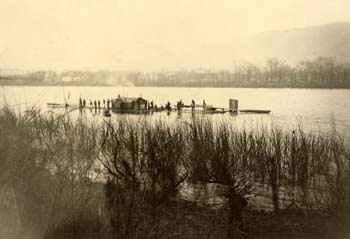
The story of the Last Raft actually began years before the tragedy, when the timber industry ruled the world of commerce in central Pennsylvania between 1810 and 1910. The Last Raft was constructed in McGees Mills, Clearfield County, as a living history exhibit of that bygone era. The plan was to float the 112-foot long white pine raft 400 miles on the West Branch of the Susquehanna River to Harrisburg, where the timber was to be sold.
According to historical accounts, fate put Taylor on the raft the day he died. He was aware of the raft’s historical significance and wanted his town to be a part of it, Poulton said. He traveled to Williamsport to convince the raft’s pilot to stop in Montgomery. The pilot agreed.
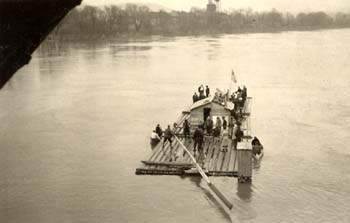
The next day hundreds of Montgomery’s townfolk turned out to greet the raft and its 45 passengers. As it approached the borough, in full view of Montgomery’s citizens, it struck the Reading Railroad bridge spilling most of the its passengers into the freezing water. Although most of the passengers were rescued, seven drowned, including Taylor. It was a month before his body was recovered.
“This was not a joy ride or thrill-seeking,” Poulton said of Taylor’s journey from Williamsport to Montgomery. “As the mayor of Montgomery he wanted to bring a piece of history with him.”
“Mayor Taylor understood the importance of history,” Feese said. “The raft was an important history lesson. Unfortunately, it was just as dangerous as the trip made by the lumbermen before it.”
According to Poulton, tragedy did not stop the raft from completing its journey. The raft remained “tied up” in Muncy, he said, until a coroner’s inquest was completed. Then it resumed the trip in true timber-era fashion.
“They mourned their dead, then they continued their journey just like they did in the heyday of rafting,” he said.
On hand for the ceremony were a group of Taylor’s descendants, including his daughter Florence Taylor Moore, who was 16 months old when her father was killed. She and Eric Taylor, grandson of Dr. Taylor, helped unveil the sign designating Route 405 Dr. Charles F. Taylor Memorial Highway.
“I didn’t remember anything (of the tragedy),” Moore said following the ceremony. “Just the memories that my mother kept, which were wonderful.”
“I’m so proud. There’s no words for it,” she said.
“I’m a little overwhelmed,” said Eric Taylor, who is the son of Charles F. Taylor Jr. “I know my father wishes he was here.”
His father, who lives in Nevada, was ill and could not make the trip to Montgomery, Eric Taylor said


Montgomery Area Senior Citizens meet for tureen dinner,
discuss Last Raft, Canal Packet Boat

Williamsport Sun-Gazette
9/21/2004

MONTGOMERY – A program about the discovery of an original canal packet boat in Northumberland County and the subsequent removal of the boat and its reconstruction by The Muncy Historical Society was presented to the Montgomery Area Senior Citizens at a recent meeting.
Bill and Linda Poulton told the surprising story of the discovery of the boat. The Poultons transported the boat to the parking lot at the church for the meeting and the group was “welcomed aboard” for the exhibit. The reconstructed cabin is the only known survivor of this era.
It was announced that the new documentary of the “Last Raft” will be broadcast by PBS on Oct. 11 on WVIA.
The senior citizens met at the St. John Lutheran Church for a tureen dinner on Sept. 7.
The by-laws committee announced proposed changes and copies were distributed to members for their review.
A ceremony will be held Oct. 11 at Montgomery Park to dedicate the section of Highway 405 and the Muncy River Bridge as the Charles Taylor Memorial Highway.


Route 405 bridge named for historic Last Raft
Highway to commemorate one of the victims

Kevin Olmstead
Williamsport Sun-Gazette
7/16/2004

The state Legislature and Gov. Ed Rendell have taken action to memorialize the seven people who died March 20, 1938, when their historic lumber raft slammed into a pier of the Reading Railroad bridge near Muncy.
The bridge carrying Route 405 over the West Branch of the Susquehanna River will be known as the “Last Raft Memorial Bridge” and the highway in Clinton Township will be known as the “Dr. Charles F. Taylor Memorial Highway,” according to a bill that unanimously passed the Legislature.
Rendell signed the bill Monday. It takes effect Sept. 10.
The Last Raft was to be a symbolic trip down the Susquehanna on a log raft commemorating the river’s history as a primary means of transportation during the region’s lumbering days. Taylor, who was burgess of Montgomery, a position similar to today’s mayor, planned to ride the raft to his borough, where he would deliver a speech about the historic trip.
Taylor was one of seven people killed when the raft slammed into a bridge pier, throwing 45 passengers into the icy river. Pilot Harry Connor and a Universal newsreel cameraman also were among the fatalities, according to the Muncy Historical Society.
Despite the deaths and damage to the raft, the crew accepted the crash as a danger that comes with the business and continued the trip to the Harrisburg area, as previous generations of lumbermen had done.
Montgomery Mayor Andy Onufrak approached state Rep. Brett O. Feese, R-Plunketts Creek Township, about dedicating the highway in honor of Taylor, Feese spokesman Charley Hall said.
“He (Feese) thought it was a good idea,” Hall said. “In the process of doing that, we decided to include the bridge, too.”
Onufrak could not be reached for comment.
The highway bridge was chosen even though it was not the bridge where the crash occurred.
“I don’t think they can name a railroad bridge” because it is not owned by the state, Hall said.
The Route 405 bridge has a significant connection to the event since many witnesses lined the span to watch the raft — and many of those spectators saw the raft crash into the railroad bridge just downstream, Hall said.
State Department of Transportation spokesman Rick Mason said he was unsure when signs would be installed, but added that it often takes “a while.”
The signs could be placed in September, when a dedication ceremony likely would be held, Hall said.


‘The Last Raft’ set to journey onto big screen
Eric Long
Williamsport Sun-Gazette
6/16/2004

MUNCY — “The Last Raft” is still alive.
Thanks in part to Muncy Historical Society, the public soon will be able to view a one-hour historical documentary about the 1938 wreck of a log raft on the West Branch of the Susquehanna River that killed six people.
The documentary’s public debut will be at 8 p.m. Monday in the Community Arts Center, 220 W. Fourth St., but news representative were given a special viewing Tuesday at the Ritz Theater here.
Along with the historical society, ‘‘The Last Raft’’ film was underwritten by foundations, government and individuals. Public Television station WVIA gave significant production support to the project and will broadcast it on a date to be announced.

Bill Poulton, executive director of the Muncy Historical Society, said the documentary project was seen as a golden opportunity by the society.
‘‘Virtually every town in America has a story about itself,’’ he said. ‘‘Muncy has a huge oral history of itself, going back to the days of the Revolutionary War. Here we are trying to save a piece of our past and we think we have done so with this documentary on the Last Raft.’’
Dan Berninger, president of Muncy Bank and Trust Co., said the bank was quick to approve funding the project.
‘‘When the historical society came and asked for a donation, our board quickly felt we could help preserve our history,’’ Berninger said.
With that, the bank gave a $5,000 donation, which was followed with a $3,000 gift when the project was in need of funds.
‘‘It is really our pleasure to be a part of this...,’’ Berninger said.

The film includes both still photos and film recorded at the time of the Last Raft’s construction and trip down the river, including some very rare color film that was recovered and restored.
The Last Raft itself was a living history project by Robert Dudley Tonkin of Cherry Tree. It was built during the winter of 1937-38.
The opening sequences of the documentary shows the man who oversaw the building of the raft and the felling of a tall pine tree for one of the raft’s timbers.
The raft was constructed entirely of wood, using traditional tools and methods. Fifty-one white pine logs were assembled on the river near McGee’s Mills. They were fastened together with hickory lash poles, white oak bows and white ash pins.
The raft had three sections, with two joints in it for flexibility. It was 112 feet long, 26 feet wide and weighed about 80 tons.
The film shows the raft being launched on March 14, 1938, as well as some of its early stops. In one, thousands of people line the river banks at Lock Haven.
It safely traversed dams at Lock Haven and Williamsport and passed beneath 23 bridges before tragedy struck.
The raft had cleared the piers of the road bridge at Muncy, but it hit one of the piers of the Reading Railroad bridge downstream on March 20, 1938. The impact threw all but a few of the 45 to 48 people on board into the icy waters. Most were rescued, but seven, including Montgomery’s mayor, drowned.
Survivors were taken to area homes and cared for, while hundreds of volunteers searched for days for the victims. The last one was found about a month later, miles downstream.
What remained of the raft was later floated to Fort Hunter, just above Harrisburg.
The documentary intersperses film footage and still photographs with interviews of survivors of the accident, descendants of those who participated in the journey and witnesses to the accident.
It is not just a straight, historical account. Thanks to the interviews with real people who were there or descendants of those who were, it gives a more human feel for the event, as if it happened yesterday or last week.

About $100,000 in funding was raised through major supporters, including the Williamsport-Lycoming Foundation, Degenstein Foundation, Margaret Waldron Foundation, the state Historical and Museum Commission, WNB Bank, the state Council on the Arts, Clinton County Community Foundation, Sovereign Bank Foundation and the Muncy Area Kiwanis Club.
Other support came from the Clearfield, Clinton and Lycoming County governments, Pennsylvania College of Technology and individuals.
The premier at the Arts Center will be in conjunction with the launch of WVIA’s Public Radio station, WVYA 89.7 FM, which is based at the center.


Sovereign Bank Foundation supports Last Raft documentary
Williamsport Sun-Gazette
9/15/2003


The Muncy Historical Society and Museum of History has received a Sovereign Bank Foundation grant to The Last Raft documentary project in the amount of $1,500.
“We are proud to support the communities where the bank is located and to be a part of this very worthwhile cause,” said Ramona D. Turpin, community relations manager, corporate communications department, in awarding the grant.
Muncy Historical Society has donated proceeds from this year’s golf tournament to the project, as well. This funding, plus recent contributions from individuals, has put support for the project at more than $78,500 to date, with about $24,000 left to raise.
“Support from the public has been outstanding,” said William Corson, Muncy Historical Society president. “A significant amount of work has been carried out on this project, and it is shaping up to be a very fine program.”
All but a few shooting days are completed. The project recently shot an interview with a man who was a passenger on the raft at the time of the crash.
Rough editing of the program is at the halfway mark. The work continues as funding continues to be raised; the program can be completed this year if funding is received in time. It will be aired on WVIA and other PBS stations.


Postcard helps ‘float’ raft
Williamsport Sun-Gazette
9/15/2003

Muncy Historical Society announced that supporters of The Last Raft Project at the $100 level and above will have a copy of the program reserved in their name, to be mailed upon completion. This also applies to those who have already contributed at that level and have helped move the project forward. A limited edition postcard featuring a previously unpublished “Last Raft” photo has been printed to help publicize that news, containing information about where to send name, address, and underwriting support (to the Muncy Historical Society, designated for The Last Raft Project).
Postcards are available at area museums and businesses.
Support for the project to date has come from The Muncy Historical Society members and fund-raising events, WVIA, the Williamsport-Lycoming Foundation, Muncy Bank & Trust Co., The Pennsylvania Historical and Museum Commission, The Margaret Waldron Foundation, Williamsport National Bank, Clinton County Community Foundation, Pennsylvania College of Technology, Lycoming County Commissioners, Clinton County Commissioners, the Muncy Area Kiwanis Club, Baltimore Life Insurance Co., and Brooks Lumber Co. Additional grants have been received from corporations, foundations, organizations, government, individuals and families.


Last Raft Finished 200-Mile Journey
1938

The Susquehanna River's disaster hit "Last Raft" bumped to a final stop last Friday at the mouth of little Fishing Creek, carrying out an old river tradition that the logs must reach their destination regardless of death on the way.

A 200-mile sentimental cruise that was started out "in fun" as a reminder of pioneer lumbering days left in its log a record of seven dead in a crash of the cumbersome raft into a bridge pier at Muncy on Sunday.

"I'm glad we could see the raft through, but I'm awfully sorry about the trouble we had," said R. D. Tonkin of Tyrone, who sponsored the "Last Raft" voyage from the Susquehanna's headwaters to "have some fun."

As the cruise came to a commonplace end with plans for a welcoming celebration abandoned because of the tragedy searchers at Muncy recovered the camera of Thomas Proffit, of Chester, Universal newsreel cameraman who "went down cranking" when the raft came to grief.

The searchers immediately redoubled their efforts to locate Proffit's body and those of the other five victims who went overboard in the crash.

Tonkin sold the raft to J. D. Bogar Jr., Harrisburg lumber dealer who said he would cut the logs for general lumber yard use.

Thirty persons were on board when the lumbering craft pulled in at Fort Hunter and tied up in the creek, but only three of them started out with it at McGees Mills last week. They were Levi Connor of Glen Campbell, a relative of Harry C. Connor, missing chief pilot, and John Meyers and Edwin Winner of Lock Haven. The three took over the piloting duties after Connor went overboard at Muncy.

Connor said he was "mighty proud" to have aided in piloting the craft on its last leg.

The raft tied up at the "old buttonwood tree" after an uneventful trip from Clarks Ferry where the crew moored Thursday night.

Mrs. M. J. McCants, curator of the Fort Hunter museum, said many treaties were negotiated under the old tree by pioneers with the fierce Susquehanna Indians.

The muddy Susquehanna River gave up the body Monday of Malcom McFarland of Indiana, Pa., one of seven victims of the "Last Raft" disaster a week ago.

The body of W. C VanScoyce of Philadelphia was recovered shortly after the craft cracked up near Muncy.

McFarland's body was recovered shortly before two divers dropped to the bottom seeking bodies of five other men who perished when the log raft hit a bridge pier on a sentimental cruise as a reminder of pioneer lumbering days.

McFarland's body was brought to the surface about 200 feet north of River Island below the Montgomery dam by a volunteer rescue worker. He took the body showing little effects of a week in the water to Montgomery. Relatives were notified and arranged to send it to Towanda.


Raft Meets Disaster at Muncy

Muncy Luminary
March 24, 1938

Tragedy stalked on the muddy waters of the Susquehanna River, Sunday noon, tragedy which unfolded before the eyes of thousands of persons a picture of “The Last Raft” hitting a pier of the Reading Railroad bridge at this place, a picture of almost all of the forty-eight persons on the raft swept into the river, struggling for their lives as the current swept them downstream, several of them going to the bottom to be seen no more.

Forty-eight persons were believed to be on the raft at the time; thirty-eight of whom were saved from watery graves, one dead recovered from the river, and six missing. W. C. Van Scoyne, 66, of Philadelphia, on a pleasure trip, is dead. His body was recovered almost immediately by Robert Mann, of Muncy, who was assisting in the rescue work in a small boat. The body was transferred to a motor boat occupied by Jud Rynearson and Webb Broscious and rushed to shore, and then taken to the hospital.

The following are notes from Muncy's Now & Then:

Four survivors were immediately taken to the Muncy Valley Hospital where they were treated for shock and exposure. They were John Bain, of Northumberland; G. W. Barto, of Milton; I. A. Henderson, of Montgomery; and John Stutzman, of Williamsport. Weighing in at 289 pounds, the rescuers had no easy task saving Mr. Barto and, in fact, he had to be lifted back onto the same raft that had dumped him into the water in order to bring him to shore.

Other survivors were taken in by the Valentine Fenstermaker family, whose home was on the river bank near the river bridge. Their home was used as an emergency hospital for the survivors, a headquarters for the searching party and its kitchen as a canteen. The Pennsylvania Motor Police used a part of the barn and yard as headquarters for their radio equipment. Mrs. Blanch McCarty, a daughter of the Fenstermakers, and a graduate nurse, was the first to take care of the survivors, later being assisted by physicians who had arrived at the scene. From the Fenstermaker home the survivors in need of the most attention were removed to the Muncy Valley Hospital.


xxx


Funds to assist with music license clearance fees and program distribution will be appreciated and may be sent to: Muncy Historical Society and Museum of History, P.O. Box 11, Muncy, PA 17756. Please mark your check for "The Last Raft Project."

SUPPORTERS OF THE PROJECT:

Muncy Bank and Trust Company
PA Historical and Museum Comm.
The Margaret Waldron Foundation
MSHMH Members
PA Council on the Arts/PA Partners in the Arts
Williamsport National Bank
Clinton County Community Foundation
Pennsylvania College of Technology
Baltimore Life Insurance Co.
Brooks Lumber Company
First USA Bank
Sovereign Bank of Muncy
National Bank of the Commonwealth
Borough of Montgomery - in memory of Dr. Taylor
Rotary of Muncy
Golf Tournament - MHS and Muncy Area Kiwanis Club
Williamsport-Lycoming Foundation
The Degenstein Foundation
Annual Antique Show and Sale
Getting in The Spirit Homes Tour
Bryfogle Trust
Kellogg Co.
East Lycoming Historical Society
Tiadaghton Chapter SAR
Bill and Linda Poulton
Ann and Birch Phillips
Jim and Jean Dow
Charles F. Taylor, Jr.
Malcolm Barlow
Jack and Sharon Bartock
Dr. and Mrs. Dudley Turner
And numerous other generous individuals


Muncy Historical Society
40 North Main Street
P.O. Box 11
Muncy, PA 17756
(570) 546-5917
MuncyHistorical@aol.com

Regular Hours: Mondays and Fridays, 9 a.m. to 3 p.m.
March through November ** except holidays **
and by special appointment.
Hours are subject to change
Check schedule by calling (570)546-5917